

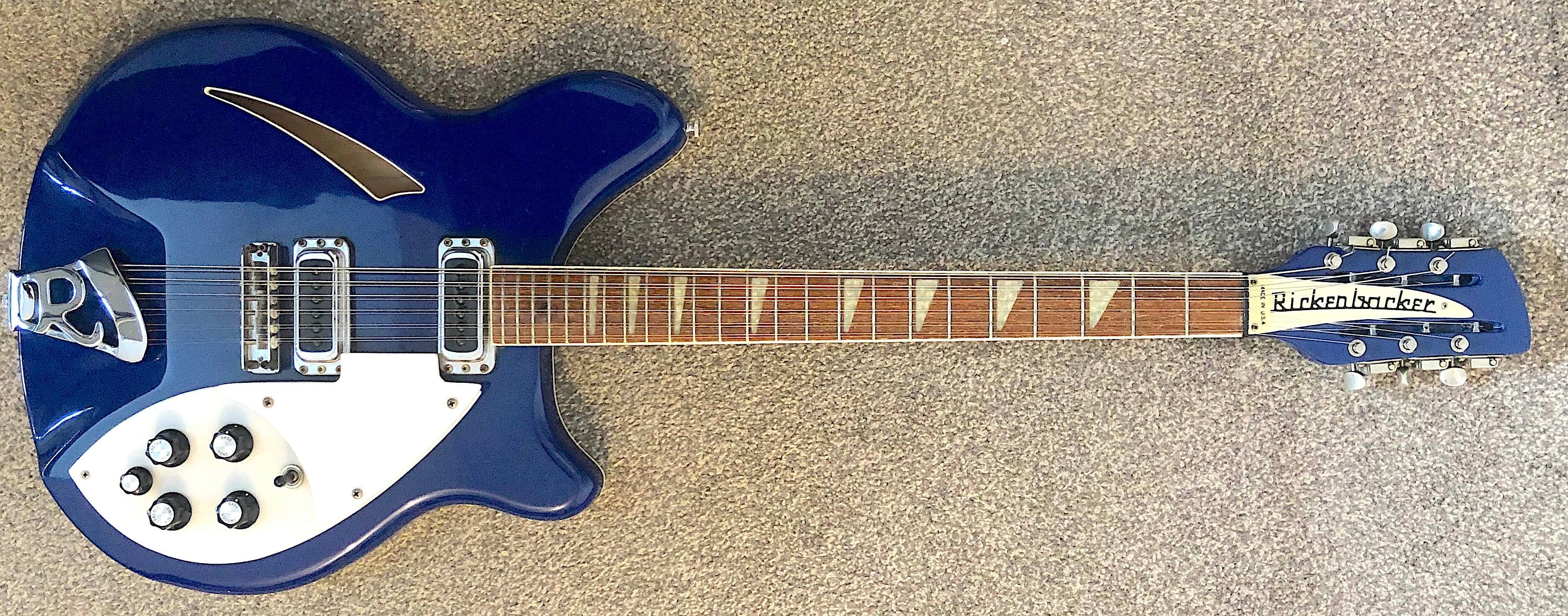
There’s nothing like the opening first track of a new LP! Choosing which track deserves that important position, the one that sums up the theme of the album, sets up the mood, is the welcome mat, the handshake, the eye contact, the hug - the first impression! It’s one of the most loaded decisions a record maker faces.
Sometimes it’s an arbitrary decision, a consensus: choose the catchiest song, the easy rocker. Yet your choice will nevertheless come to signify the entire experience. Think of an LP, and you’ll probably recall the first song, and may struggle to remember the subsequent track order, without running through the whole thing in your head!
For Squire LPs, the choice is always instinctive. The Life on Get Smart says everything - like a fanfare, a manifesto! September Gurls, obviously, that intro with that guitar sound! And even the first ever single, Get Ready To Go, the keen frenetic three quarter sized Rickenbacker making a bold statement, pushing every conceivable chord into the first four bars! I could go on…!
For Smash? It was always going to be Slip Away!
The first note you hear is the 12-string Rickenbacker. It’s the fastest song on the record. It’s explosive. It connects everything together - the tension, the intention, the determination, the two sides of the coin, the two sides of consciousness, inside and outside, the two continents, London and Los Angeles, and the invisible silver thread that connects them. Am I on the inside looking out, or outside looking in? Am I homesick in LA, or longing to escape London?
Slip Away lands like jumping onto an already fast-moving merry-go-round. It’s already out of control. The verses sit stubbornly on one chord, like speeding down a one-way street, relentless - a simple pentatonic melody underscored with a motorific beat, the engine. Then the realisation: I don’t need a train or a plane, or a wave goodbye. All I have to do is close my eyes. And I’m back wherever I want to be again. London, LA, in, out, up, down. I’ve slipped away.
Like all the tracks recorded for the album, it was recorded direct to the four-track tape machine. The sessions moved fast. With that came a relentless forward motion - no second chance, second guess or second version. The songs sit tightly next to each other on the analogue tape. There isn’t even a minute of silence between them for fades or safety. Instead they crash into each other and begin to segue, as though they’re destined for side two of Abbey Road. The session ended when the tape ran out, not when the songs ran out.
Within that speed of recording, ideas and ways of playing seemed to affect the songs as a group. There is a perhaps unintentional guitar figure that appears on at least three songs - and it’s here in Slip Away, going into the first I don’t need a train section. Unconsciously played and only recognised afterwards. As though a co-writer had quietly joined the song’s creation.
The instrument as signifier
Instruments act not only as riffs, rhythm and character - they act as signifiers as well. They connect the music to a particular era, a genre, a place. And the 12-string guitar is one of the most loaded signifiers in the whole of popular music.
The instrument first came to wide attention on the hit single Walk Right In by The Rooftop Singers - an acoustic folk song released in January 1963 that spent two weeks at number one on the US Billboard pop chart, reached number ten in the UK chart, and stayed high in the chart for twelve weeks. But it was what happened next that changed everything.
The song that truly established the 12-string sound in pop music was, of course, the opening chord of A Hard Day’s Night - George Harrison’s electric 12-string Rickenbacker, so upfront as to obliterate everything else on the record. And then the follow up single Ticket to Ride. The 12-string became the new secret weapon of The Beatles’ signature sound, instantly replacing the Merseybeat/soul/girl group mix with a futuristic sonic salvo of turned-up treble. It was ubiquitous to the sound of the era, and soon enough you could hear it on Mr. Tambourine Man, and then, when The Beach Boys joined in on Wouldn’t It Be Nice, it came to signify the sound of California.
Looking at the evolution of music in the 1960s, music historian Richie Unterberger has also observed a seismic shift in how records were heard. Up until then, records were either live recordings or novelty records. Afterwards, the creation of signifiers added a third layer of meaning…
That third layer of meaning is precisely what the 12-string carries. You have the melody and lyrics, and then the soundscape carries something else entirely, not just accompaniment, but sounds that evoke memory, borrow styles from adjacent music to suggest you belong to a genre, or catch a sonic silhouette that becomes the main feature of the song. A 12-string is not just an electric guitar, its not just the sound of a guitar on steroids, its particular shimmer is unique, and when you hear it you hear beyond what the player is performing and listen unconsciously to what the sound is evoking. It reminds you of other music, you’ve heard it before, it must mean something!
Indeed, the instrument came to signify the West Coast more than The Beatles’ hard-hitting introduction. By the time of If I Needed Someone on Rubber Soul, it sounded as though George Harrison was referencing The Byrds rather than the other way round. And after that song, he never recorded with it again. The Beatles reinvented their sound once more with Revolver, stepping away from the jangle and into something stranger and more expansive.
But the essence of the 12-string shimmer remained in the culture. Hotel California by The Eagles, the rolling arpeggios that open the track and underscore the verses, owns the Laurel Canyon folk revival era. The instrument had become a sonic shorthand for wide open spaces, for the California dream, for a certain kind of yearning.
A strange period for guitars
The 1980s were a peculiar moment for the 12-string, and for guitars generally. In a sea of synth pop, the guitar sounded retro; the band sound was nostalgic rather than searching for new expression. Records featuring the instrument were either ironic or reaching back towards a prior authenticity. And there was a further complication: the 12-string is genuinely difficult to record cleanly and keep in tune, which is partly why its presence on pop records of the era, that are defined by precision, modernity and perfect tuning, was often more implied than actual.
The Smiths are forever associated with the sound, Johnny Marr and his black Rickenbacker epitomised the image of the new guitar god, but their studio approach typically involved a Fender Telecaster with an effect rather than a genuine 12-string. What Morrissey and Marr achieved was something more subtle, an arpeggio style that paid homage to 1960s guitar fluidity, while overlaying the sound and spirit of early 1960s female-fronted pop, creating a peculiar tension between a back to basics accompaniment and traditional British pop. The 12-string signified a lineage connecting back to a time when guitar hero meant Harrison and McGuinn, not Clapton and Page. What made it modern was a rhythm section that never quite loosened up.
REM used the Rickenbacker sound differently, to create a garage-band energy within an Americana framework. For them it signified wide open spaces, and the claustrophobia of playing in clubs at the end of a dusty journey.
And when you’re not paying attention, you’re still hearing it. The opening notes to the theme to Friends? The Rembrandts with a 12-string! The opening credits to UK daytime soap opera Crossroads, running from the 1960s through to the 1980s? A 12-string! (played by Vic Flick, who also played the Bond theme). It never really went away.
The 12-string Rickenbacker had already become a signature sound of Squire in the very early days, featured on the My Mind Goes Round in Circles / Does Stephanie Know single and forever played live as the main guitar sound. You come to expect it to show up eventually, and might feel quietly cheated if it doesn’t.
But there is also a risk with any signifier: overuse eventually transforms the original meaning. Phasing, for instance, once connected powerfully as a key signifier of the psychedelic experience, has gradually come to signify 1960s novelty sound effects rather than its original counter-cultural charge. By the 1980s, the 12-string risked something similar, sliding from genuine signifier into mere period costume, a sonic cliche from the past.
Using it on Smash was therefore a knowing, loaded choice, not simply a sonic preference. Is there ever a right time to disconnect from the past and make a ‘new’ record?
Back to Slip Away
The 12-string is on Slip Away because I picked it up to play, to contrast to the six-string rhythm guitar that drives the song. But as soon as I started, the sound suggested itself, and the style was an improvised blast from beginning to end. One take. It had to be. You can’t drop in to repair anything when you’re recording to a primitive four-track tape machine. And that one-take-or-bust methodology creates the excitement. The few wrong notes are suddenly the right notes as you wayfair your way to the end of the song.
It’s a trip. In every sense. Sensory overload. And in its way, it not only signifies California overlaid on top of a very British backing track, it connects across to a myriad of unconscious influences and counter-cultural references - and you know who it is as well!
On Smash, it arrives with the very first note. The album opens, as it always was going to, with a Smash!